Choose the area you can leave uncut
The first decision is where the lawn can behave differently in spring. Walk its ordinary routes: gate to shed, house to compost, hose to tap, and the turn at the end of a mowing pass. Exclude those routes before imagining a drift of flowers. If every part of the lawn is used frequently, a border planting may achieve the same spring color with a more workable maintenance boundary.
The RHS recommends choosing grass that is not regularly walked on and can remain unmown through the bulb’s active season. Its mowing guidance waits until foliage has died back and yellowed, commonly around six weeks after flowering. The plant’s condition determines readiness; six weeks is not permission to cut leaves that remain green. RHS: Planting bulbs in grass
For a small drift, the useful shortlist is simple: plant markers to keep the boundary identifiable and a trowel for individual pockets. Put rigid markers at visible safe edges outside mower travel. Buy additional equipment only after checking whether the soil and scale justify it.
Specify wild daffodil instead of a generic yellow mixture
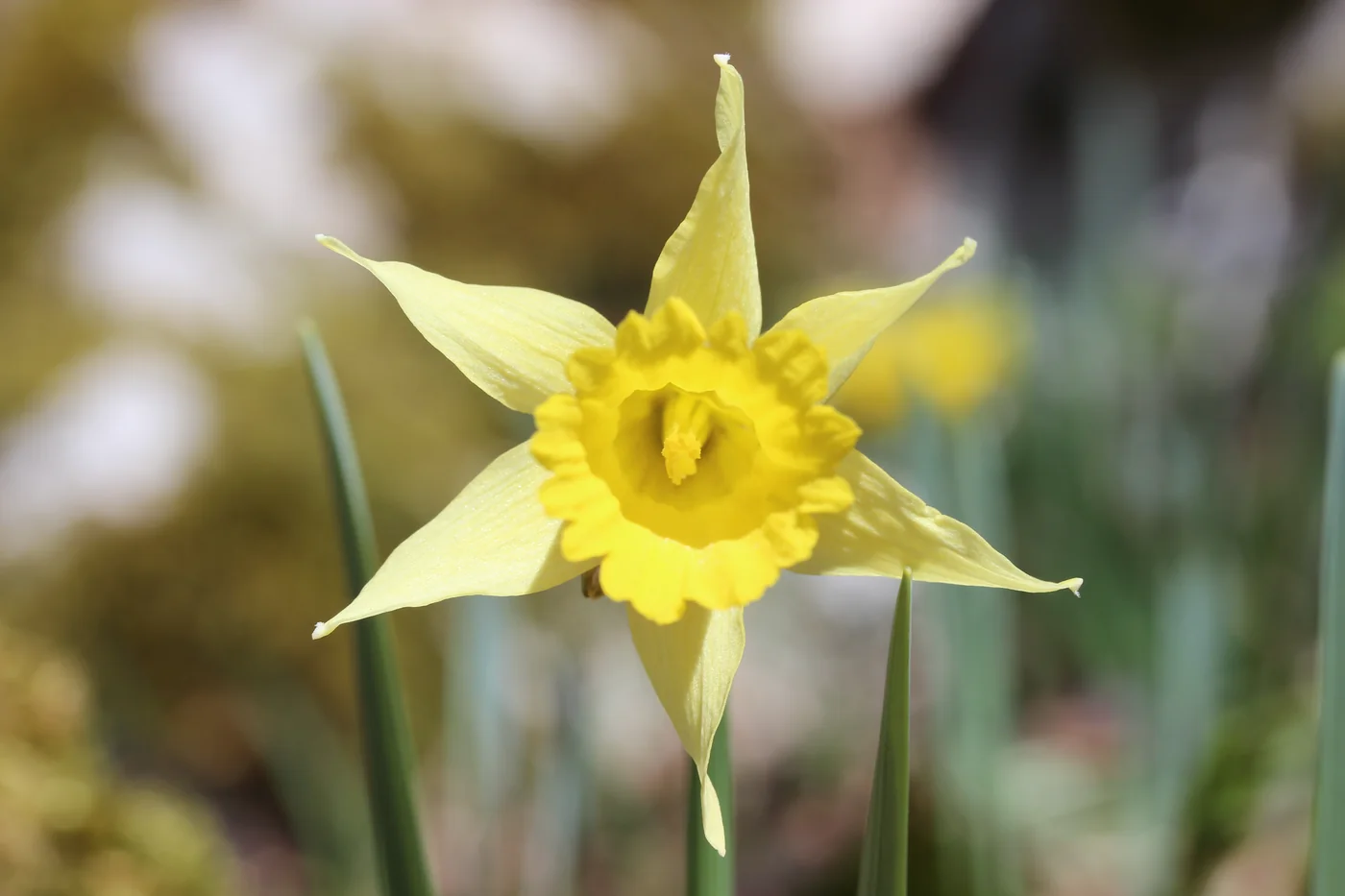
If this is a planting of wild daffodil, ask for Narcissus pseudonarcissus with any subspecies or form recorded. The species is a modest trumpet daffodil, not a catch-all name for every large yellow hybrid. RHS lists it in the natural-species division. A packet labeled naturalizing daffodils may contain a different selection or a mixture, so that marketing phrase alone does not establish the plant. RHS: Narcissus pseudonarcissus species profile
Choose the purchase that matches your actual goal. For a botanical species collection, traceable identity matters. For a decorative lawn feature, a named garden selection may be appropriate, but compare its own flowering season and height. Keep it out of a species-labeled planting unless you are comfortable describing the result as a mixture.
Use nursery-propagated material and retain the supplier details. In North America, this European daffodil is an introduced ornamental even where it persists without replanting. A natural-looking effect does not establish local native status. That distinction matters if the site is intended to be a native meadow or restoration planting.
Draw an outline the mower can follow
Lay out a trial boundary before buying bulbs. A hose or loose rope can show the proposed edge while you walk the normal mowing route around it. Check turning room, slopes and narrow passages using the equipment you actually have. An elegant shape on paper is a poor choice if its neck is narrower than the mower or its edge forces repeated reversing.
Make one or two clear drifts rather than scattering bulbs through every isolated opening. A visible boundary helps visitors avoid trampling and makes seasonal instructions understandable. Include a viewing edge so flowers can be enjoyed without entering the planting. The edge should remain recognizable once grass and daffodil leaves are similar in height.
Photograph the outline from fixed points and note its dimensions. As a planning example, one modest drift beside a path may be easier to preserve than the same bulb count dispersed throughout the lawn. Compare the work of maintaining the boundary, not just the number of bulbs or the area the flowers might eventually occupy.
Check what the grass site hides underground
Inspect spring light, runoff and the soil before treating all grass as equivalent. NC State describes wild daffodil as suited to sun or partial shade and moist, draining soil, with bulb rot a concern in wet ground. A low area that stays saturated after rain should be removed from the bulb plan even if its grass looks vigorous. NC State Extension: Narcissus pseudonarcissus
Probe a few representative planting pockets to learn whether you face dense tree roots, compacted fill or suitable soil. If the intended drift crosses several different conditions, shorten it or split it into separate trials. Avoid forcing identical bulb placement through roots simply to preserve a drawn pattern. Keep established trees’ major roots intact.
Consider the summer routine too. A lawn watered heavily for continuous summer growth may present a different bulb environment from a lightly managed grass area. You do not need to redesign every irrigation zone immediately, but you should know whether the proposed drift sits in an especially wet overlap or near a leaking outlet before planting it.
Buy for a measured first phase
Set the initial quantity from the area you can plant and protect this season. Leave expansion room on the sketch, but do not purchase as though every future phase must be completed now. A first phase can reveal whether the mowing boundary is respected, whether the spring view is satisfying and whether the grass growth makes the waiting period acceptable.
Inspect bulbs while the supplier label is still with the batch. General RHS buying advice favors firm bulbs without mold. Compare like-for-like material when assessing size; an identified species batch is not necessarily inferior because its bulbs are smaller than those of an unrelated large hybrid. RHS: Growing daffodils
Count sound bulbs and revise the layout before planting. Keep any extras identified for a real second location rather than distributing them randomly at the drift’s edges. Random additions are easily forgotten when mowing resumes. Record the planted count as a baseline, accepting that future clump growth will make individual bulb counting less meaningful than observing the overall flowering patch.
Arrange the planting day around access and identity
Keep the layout visible and work in a direction that avoids stepping on newly restored turf. Place only the batch you can plant promptly; this reduces the chance of overlooking bulbs in the grass. Keep tools and packaging beside the working edge, and check the whole area before finishing. A bright temporary marker can identify completed sections during a larger session.
Use the regional spring-bulb guide for seasonal timing, depth interpretation and drainage preparation. Follow the instructions for your identified bulb batch. This project’s extra requirement is the durable connection between the underground planting and the future mowing boundary.
After planting, take a photograph that includes fixed objects such as a path junction or fence post. Record where bulbs were omitted because of roots or unsuitable soil. If another person maintains the lawn, provide the actual marked boundary and the foliage-stage instruction. A vague request to leave the daffodils alone is easily misread once the flowers disappear.
Manage the spring handoff without a fixed cut date
Inspect the outer edge as growth begins. A few emerging shoots beyond the mapped line may mean the outline was recorded poorly; correct the boundary while it is easy to see the plants. Keep normal access clear, and avoid moving paths into the drift merely because the grass outside it has become temporarily muddy.
As flowers fade, decide whether seed formation belongs in the plan. RHS permits seed heads in naturalistic daffodil drifts where self-seeding is wanted. That is a separate choice from leaf removal: leaving or removing the spent flower does not change the need to retain functioning foliage. RHS: Growing daffodils
Recheck the latest-flowering portion before resuming cutting. A mixed planting may not finish uniformly. If one section still has green leaves, keep its boundary for longer instead of treating the earliest faded flowers as the clock for the entire drift. When the leaves have finished, resume the grass-care routine appropriate to the site, with all markers clear of moving blades.
Expand only after the whole season works
Assess three outcomes separately: spring flowers, the period of uncut grass and foliage, and the return to normal access afterward. A planting can flower well but still fail as a design if its boundary blocks the only useful route. Solve that conflict by changing the footprint or choosing a border position for future bulbs.
Where flowering declines, review mowing history, shade and moisture before assuming overcrowding. The division guide explains when a congested clump merits lifting; this lawn plan should not create a routine annual digging job. Keep notes on the location of weak patches so a future inspection is targeted.
Expand into conditions similar to the successful section and extend the marked boundary deliberately. If maintenance repeatedly cuts the leaves too soon, reduce the drift to an area you can preserve. The practical return on this planting is recurring spring color within an accepted seasonal grass routine, not the largest possible number of bulbs hidden beneath the lawn.
Sources & further reading
We favor university extension guidance and original product documentation. Linked sources support the specific facts cited; they do not endorse Garden Gear Atlas.
- RHS: Narcissus pseudonarcissus species profile
- NC State Extension: Narcissus pseudonarcissus
- RHS: Planting bulbs in grass
- RHS: Growing daffodils
.jpg)