
Start with the tube you actually own
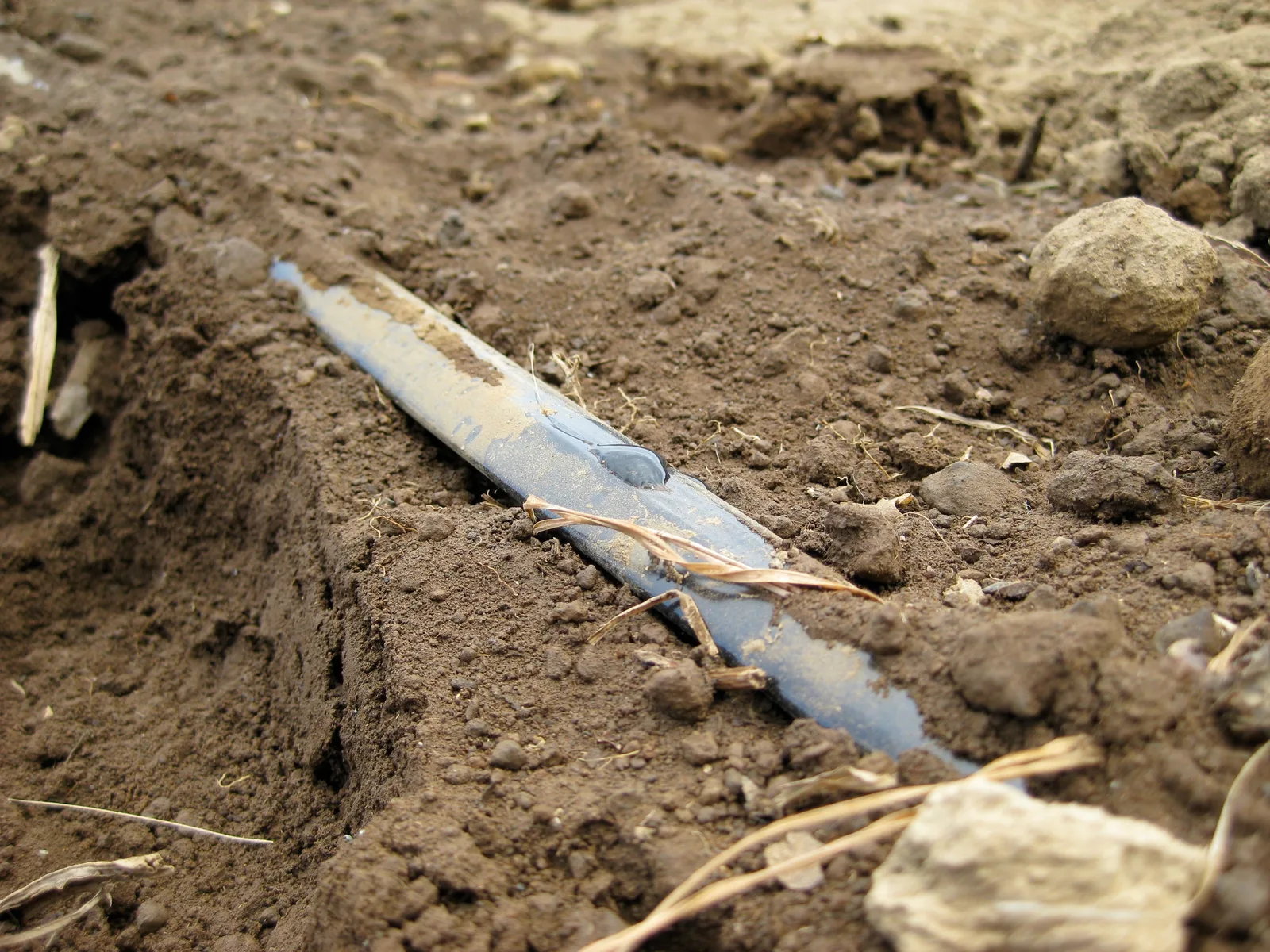
A replacement fitting is easier to choose when the existing tube has an identity. Look for printing along the tubing, the original packaging, a receipt or a saved manufacturer page. Record the exact model, material and whether the tube is blank distribution tubing or contains built-in emitters. Photograph the markings before they weather away. A bag of similar-looking black parts is not enough information to identify a connection standard, and a previous installer’s label may describe only the nominal size.
Rain Bird calls T63-100 half-inch blank tubing, yet its specification table lists a 0.63-inch outside diameter and 0.54-inch inside diameter. ET25-50S2 is quarter-inch emitter tubing with 0.25-inch outside diameter and 0.17-inch inside diameter. The two products also perform different jobs: one distributes water without built-in outlets; the other applies water along its length. Record both dimensions exactly as published rather than deriving them from the nominal name. Rain Bird: T63-100 specifications. Rain Bird: ET25-50S2 specifications.
Identify which surface the fitting engages
A compression fitting surrounds the tube, making the outside diameter central to its stated acceptance range. A barbed fitting enters the tube, so the manufacturer may specify the tube’s inside diameter and material. Never substitute one dimension for the other simply because the numerical value looks close. Rain Bird’s Easy Fit compression family explicitly accepts outside diameters from 0.630 to 0.669 inch. That is a useful, bounded dimensional statement, accompanied by pressure and above-surface installation restrictions. Rain Bird: Easy Fit compression system.
As a dimensional example, T63’s published 0.630-inch OD falls at the lower end of that interval. Its 0.540-inch ID is irrelevant to that particular OD comparison. This calculation says only that the listed outside diameter lies within the published interval; the specific fitting instructions still control assembly and use. Do not transfer this family’s range to an unnamed connector that happens to resemble it. Identify the exact fitting before using its specification as your evidence.
Read ranges, exceptions and conflicting numbers
Fitting pages may contain more than one product family, adapter size or revision. Find the exact model row and distinguish the range accepted by one end from the other. DIG’s compression-fitting page, for example, includes reducing couplings for joining different outside diameters. Their two ends intentionally differ. A reducer is useful when the parts genuinely belong to different sizes; it does not make every fitting bearing a half-inch label interchangeable. DIG: Compression fitting dimensions.
If text conflicts with a table, keep the disagreement visible. DIG’s 17 mm barbed-fitting page describes 0.570–0.600-inch ID tubing in its overview but 0.550–0.600 inch in its specification list. A tube in the disputed portion requires clarification for that fitting; selecting whichever statement permits the connection would hide the uncertainty. This is also why rounding a measurement to “about half an inch” is unhelpful. Small published differences can define which product or revision you need. DIG: Barbed fitting specifications.
Use measurements to identify, not force, a fit
When markings are missing, take a clean, undamaged offcut to the supplier or measure it with calipers. Measure the outside gently in more than one orientation without flattening the soft tube. Inspect the cut end for an oval shape, a stretched mouth, a split or a thickened section near an emitter. A distorted end is a poor representation of the original tube. Keep the sample dry and label where it came from so it remains useful when comparing several circuits.
For inside diameter, avoid taking a reading across an internal emitter or a previously stretched connection. Record the measurement’s uncertainty instead of implying precision the tool cannot provide. If repeated measurements straddle the fitting’s published limit, seek model identification or a manufacturer-approved transition. Do not shave the tube, enlarge its bore or use heat to make incompatible dimensions appear workable. The component checker compares numbers you supply; it cannot inspect a worn sample, determine the polymer or establish an unknown manufacturing tolerance.
Treat threads as a separate connection problem
A tubing adapter has two different interfaces. The tubing end may fit perfectly while the threaded end belongs to a different standard. Record nominal thread size, male or female form, and the standard explicitly named for each mating part. Hunter distinguishes tapered NPT threads from other thread forms and explains that straight-thread connections use a different sealing arrangement. Similar diameter alone cannot establish that two threaded parts belong together. Hunter: Pipe-thread types.
For the inventoried Rain Bird examples, the 1ZEHTMR page explicitly identifies its outlet as Garden Hose Thread, while the corporate inline-regulator page identifies PSI-M30X-075 inlet and outlet as three-quarter-inch female NPT. Those descriptions do not authorize joining the timer directly to the regulator. The transition needs its own documented interfaces. Do not interpret a generic “male threaded” description or an abbreviation in a model code as verified GHT, NPT or BSP. If a standard is absent, leave that connection unresolved. Rain Bird: 1ZEHTMR timer specifications. Rain Bird: Inline pressure regulators.
Check what a kit does and does not specify
A manufacturer-declared combination can be useful even when a product page lacks a complete dimensional drawing. Rain Bird’s FCKIT-1PK page shows the kit with T63-100 tubing and a 1ZEHTMR timer. It lists a backflow device, mesh filter, 25 psi regulator and tubing adapter. That establishes a documented application for those named products. It does not publish an exact OD or ID acceptance interval for the kit’s adapter, so it cannot settle every third-party tube substitution. Rain Bird: FCKIT-1PK faucet connection kit.
Keep your shopping note specific: “adapter for this tubing model and this faucet connection,” followed by any verified dimensions. Ask for missing information before cutting a whole layout to suit the new fitting. Check whether the component is approved above ground, below ground or only in an accessible service position. Also establish the pressure allowed at that part. A connector that seals during a brief low-pressure trial has not demonstrated performance through normal operation, shutdown and later seasonal changes.
Make the repair easy to verify next season
Assemble according to the exact fitting instructions using a clean tube end and the specified insertion method. Keep soil out of open tubing, then flush after repairs before closing the circuit and inspecting it under operating conditions. Colorado State specifically recommends flushing after breaks and repairs to reduce subsequent emitter clogging. This maintenance step is separate from checking whether the new joint leaks. Colorado State: Drip irrigation for home gardens.
Observe the repaired connection during a normal cycle and look again after shutdown. Mark its location on a simple circuit sketch and retain the fitting package or model photograph. Store replacement pieces in bags labeled by exact dimensions and family, especially if the garden contains both large distribution tubing and small emitter laterals. If the joint leaks, stop and revisit identity, damage, insertion and pressure before buying stronger clamps. A useful repair ends with a known connection that can be serviced again, not merely a connection that resisted the first pull.
Sources & further reading
We favor university extension guidance and original product documentation. Linked sources support the specific facts cited; they do not endorse Garden Gear Atlas.
- Rain Bird: T63-100 specifications
- Rain Bird: ET25-50S2 specifications
- Rain Bird: Easy Fit compression system
- DIG: Compression fitting dimensions
- DIG: Barbed fitting specifications
- Hunter: Pipe-thread types
- Rain Bird: 1ZEHTMR timer specifications
- Rain Bird: Inline pressure regulators
- Rain Bird: FCKIT-1PK faucet connection kit
- Colorado State: Drip irrigation for home gardens