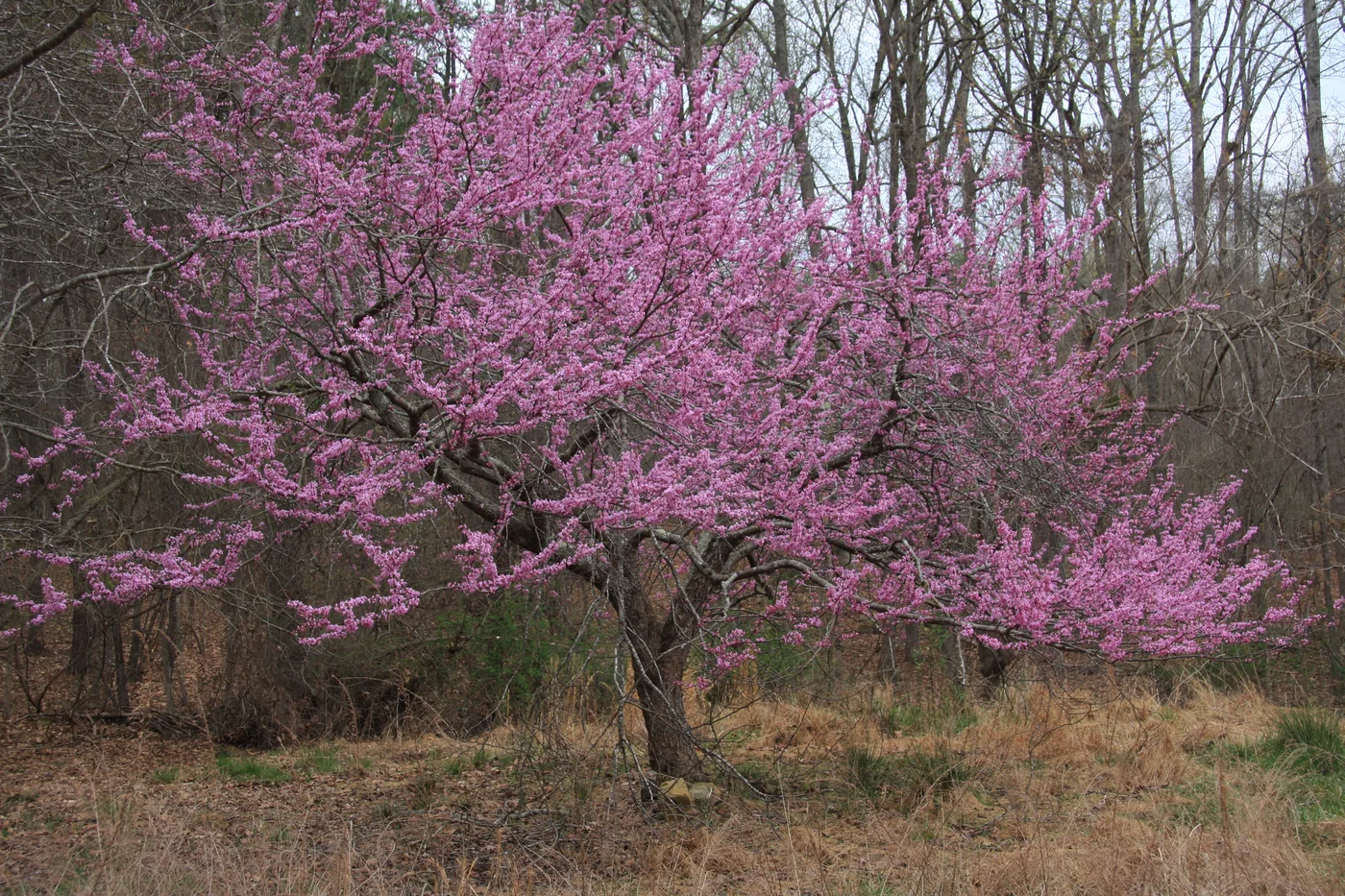
Recognize the species before choosing a garden role
The familiar eastern redbud has a brief period when flowers seem attached directly to bare branches and even the trunk. This flowering habit is normal. Heart-shaped leaves then fill out the crown, and flattened pods can remain after the leaves fall. A brown pod is a fruit, not a dead twig. The effect suits a woodland edge or a mixed border where the whole tree can be seen across the seasons. Illinois Extension: redbuds in the landscape
This reference describes the ordinary species form. Weeping, dwarf, gold-leaved and purple-leaved selections need their own verified dimensions and care details. Nor does a tag reading simply “redbud” establish that the plant is eastern redbud rather than another Cercis species. Keep the full botanical name and cultivar name with the purchase record. If your goal is a broad, green-leaved tree, inspect the summer habit in the nursery or a local collection instead of choosing entirely from flower photographs.
Allow for the crown that follows the young vase
A young upright plant can disguise the eventual spread. Redbud commonly develops a rounded or flattened crown on a short trunk, sometimes with several main stems. At a proposed location, measure from the trunk position toward windows, roof edges, walks and neighboring plants. For a 30-foot-wide crown, a simple planning sketch extends about 15 feet from the center in every direction; this is an illustration of spread, not a guaranteed setback or root boundary. The Morton Arboretum: redbud
Use the small ornamental tree guide to compare that outline with other options. A wide bed can accommodate low branches that would obstruct a narrow walk. A place that requires repeated severe cutting to maintain access is a poor match for the ordinary species. Permanent container growing also adds substantial root, water and winter-management demands; buying a container-grown nursery tree does not mean that nursery container is its long-term home.
Resolve regional tolerance before relying on the zone number
Published redbud drought ratings are not uniform: NC State warns about heat and drought stress, while UF/IFAS describes established-tree adaptability and recommends summer irrigation during dry spells. These accounts should not be averaged into a promise that an unwatered transplant will cope anywhere. A sheltered, well-drained position with access to water is a more defensible starting point. NC State Extension: eastern redbud UF/IFAS: eastern redbud
In northern gardens, ask where the seed strain originated and where it has survived winters. Wisconsin Extension identifies northern strains while cautioning that not all cultivars share their hardiness. A local sales address alone does not reveal a tree’s origin. In hotter gardens, afternoon shade and the particular redbud lineage become more consequential. Use a nursery’s regional performance record to narrow the choice; when that information is missing, retain the uncertainty in the plan rather than buying on the broadest zone range printed online.
Plant a manageable young tree and inspect the root transition
Redbud is easier to transplant young and resents root disturbance once established. Choose its permanent position before purchase. Ask to inspect a container plant’s roots and trunk base; an attractive canopy should not distract from tightly circling roots, buried bark or a loose root ball. Keep the ball moist during transport and handling. The root-flare planting guide explains how to find the reference point for depth without treating the pot’s soil surface as automatically correct. Maryland Extension: planting a tree or shrub UF/IFAS Gardening Solutions: redbud
After planting, check both the original root ball and soil immediately outside it. A single damp patch at the edge does not establish that the center received water. Make the trunk easy to approach for inspection, while routing mowing and string trimming away from it. The young-tree rooting-area guide helps turn that intention into a bed you can maintain. Establishment care belongs on the garden calendar through changing weather, even when spring growth looks encouraging.
Maintain moisture without assuming more fertilizer is better
Water should reach the establishing root zone and the surrounding soil into which roots are expanding. Minnesota Extension emphasizes that a newly planted tree needs more frequent attention than an established one and that irrigation coverage must expand with the roots. Its numerical establishment schedules are written for Minnesota; use local guidance and soil observations to adapt the routine. A timer’s operation is evidence that it ran, not that the roots received a useful distribution of moisture. Minnesota Extension: watering newly planted trees
Redbud belongs to the pea family but does not fix atmospheric nitrogen through root nodules, a distinction Illinois Extension specifically highlights. That fact does not create a need for routine feeding. If growth or foliage raises a nutrition question, use the soil-test interpretation guide to separate pH, nutrient supply and root stress. Record the question the test is meant to answer. Fertilizer is not a repair for buried bark, saturated soil or a root ball that repeatedly dries out. Illinois Extension: redbuds in the landscape
Keep useful branches and investigate progressive dieback
An irregular outline is not automatically a structural defect. The practical concern is how major branches attach and how their size and position develop. UF/IFAS highlights crowded forks and breakage susceptibility. Make decisions early, with the natural broad habit in mind, and use the paired young-redbud structure and space guide to decide which limbs can remain, be shortened or need assessment. The existing branch-collar guide covers small, reachable removal cuts. UF/IFAS Gardening Solutions: redbud
Cankers, Verticillium wilt and other problems can also produce decline. Maryland’s species reference identifies these diseases, but a photograph of one wilted leaf cannot establish which is present. Note whether symptoms involve isolated leaves, a whole shoot or an enlarging section of the crown. Photograph the affected branch, its attachment and the tree base; include recent drought, wet soil and injury history when requesting diagnosis. Avoid interpreting a newly dead branch as merely a shape problem that calls for more cosmetic pruning. Maryland Extension: eastern redbud
Use seed propagation when variation is acceptable
Redbud seed has a resistant coat and an embryo that needs dormancy treatment. Iowa State’s procedure uses scarification followed by five to eight weeks of moist chilling at 35–41°F. Follow its complete procedure if growing from stored seed; refrigerating a dry pod alone is not that treatment. Label the collection source, preparation and dates so the result can be interpreted. Iowa State Extension: germinating redbud seeds
A seedling project also needs a destination. Decide how many young trees you can grow on and where they could eventually be planted before collecting a large quantity. Named selections are propagated to preserve their traits; seedlings should not be assumed identical to a cultivar parent. Retain a few well-labeled plants when variation is welcome, or buy correctly identified nursery stock when the landscape requires a particular form. Keep a photograph of the mature source tree if possible, while recognizing that it records the parent rather than guarantees the offspring. Wisconsin Extension: eastern redbud
Sources and scope
Research-based guidance informed by institutional references. Cultivar, region and growing conditions can change the advice. Product inclusion does not imply hands-on testing of every model.
- NC State Extension: eastern redbud
- UF/IFAS: eastern redbud
- Wisconsin Extension: eastern redbud
- Illinois Extension: redbuds in the landscape
- Maryland Extension: eastern redbud
- The Morton Arboretum: redbud
- UF/IFAS Gardening Solutions: redbud
- Iowa State Extension: germinating redbud seeds
- Maryland Extension: planting a tree or shrub
- Minnesota Extension: watering newly planted trees