Keep the painted form attached to the name
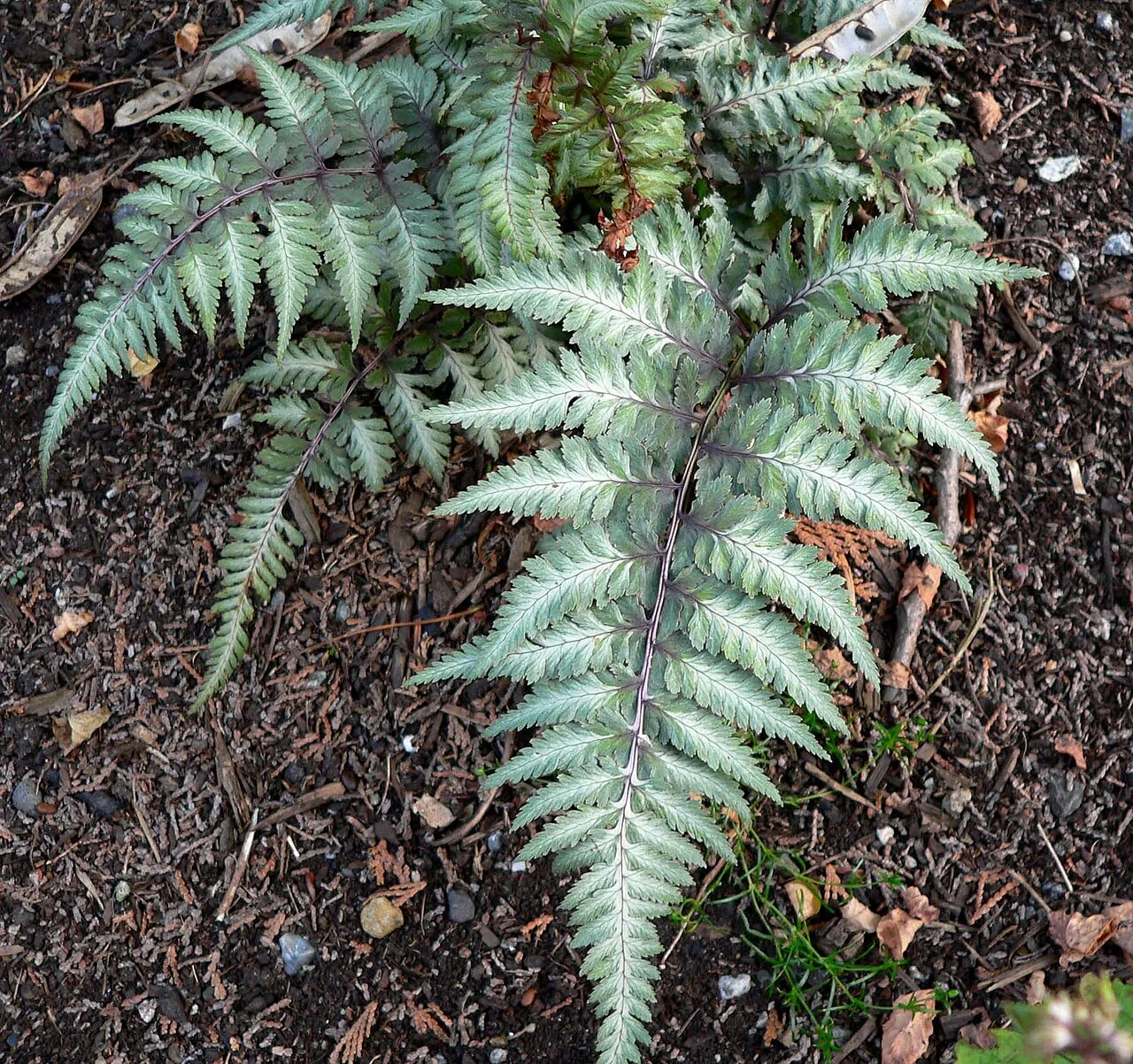
RHS retains Athyrium niponicum var. pictum and lists Athyrium niponicum ‘Pictum’ and A. niponicum f. metallicum among its synonyms. NC State presents the painted fern under the broader A. niponicum entry. These horticultural treatments differ; the painted form should remain explicit when purchasing. RHS: Athyrium niponicum var. pictum NC State Extension: Japanese painted fern
Do not shorten the shopping list to fern or even Japanese fern if color is the main design objective. Ask for the named form or cultivar and retain that information with the plant. An all-green relative could be attractive while still failing the intended purpose of a silver-and-purple planting.
Photograph the label alongside the actual fronds. A catalogue image may represent another selection or a different growth stage. Your record should answer which plant arrived, not merely what the planting was supposed to look like. That becomes particularly valuable if you later divide the clump or compare nursery replacements.
Design around a low, unfolding canopy
Morris Arboretum describes the painted form's burgundy midribs and veins against silver-green leaflets. Its discussion connects the name pictum with that colored appearance. Morris Arboretum: painted fern names
Use the fine pattern where it can be seen without constant disturbance. A protected edge of a shade bed, viewed from a seat or a path, can give the fronds an appropriate role. A narrow strip where bags, pets, or hoses repeatedly sweep through the foliage is a less forgiving position, even if the light is suitable.
Compare the fern with the leaves beside it. One broad-leaved neighbor can make its fine divisions easier to appreciate; many strongly patterned plants may compete for attention. Consider the background as well as the plant itself. A trial placement in its nursery pot allows you to assess the composition before committing to a repeated planting.
Inspect the shade bed through a dry interval
A shaded surface does not establish that the root zone holds enough moisture. Look beyond the immediate planting hole. Note whether the site sits beneath a roof edge, an evergreen canopy, or mature tree roots, and whether water delivered there reaches the intended area. Check conditions during the kind of dry interval you actually experience locally.
Purdue describes Japanese painted fern as a partial-to-full-shade plant requiring adequate moisture in well-drained soil. Purdue Extension: Japanese painted fern
The practical question is whether you can provide that combination without repeated emergency visits. If the proposed bed remains dry while nearby shade soil stays moist, compare the two locations before installing irrigation or buying amendments. The dry-shade tree-root guide helps evaluate root competition and planting opportunities. You can borrow its site-assessment approach without treating this fern as a universal dry-shade groundcover.
Leave room for the clump and your hands
NC State describes gradual spread through compact, creeping, branching rhizomes. NC State Extension: Japanese painted fern
Allow the clump's outline to develop before filling its margins with other vigorous plants. Mark a reasonable future footprint, then check whether a neighboring groundcover will cross it. A fern that disappears beneath other foliage has not necessarily failed to grow; the composition may have given faster neighbors too much control of the space.
Keep a route to the base that does not require pushing through newly unfurling fronds. This matters for watering, hand weeding, and inspection. Place a permanent marker beside, rather than through, the growing area. When the plant is dormant, the marker should show where to avoid digging or placing another plant.
If a bed needs to look full immediately, use movable pots nearby instead of planting permanent competitors inside the fern's intended space. You can move those pots as the clump develops without disturbing its root system.
Keep seasonal cleanup precise
RHS advises removing dead or ragged fern fronds before new growth unfurls, cutting near the base while avoiding developing fronds. RHS: growing ferns
Translate that into a careful inspection rather than a fixed-date chore. First identify old stems, then look for emerging growth among them. Clear loose material enough to see where a cut will land. If you cannot reach a stem without cutting across fresh growth, postpone that individual cut or leave it in place. A slightly untidy base is preferable to preventable damage to the display you are trying to encourage.
Do not use the same cleanup motion you use on a broad patch of lawn-edge perennials. This is a small plant with a detailed canopy. The painted fern frond-care guide covers how to distinguish an old frond, a damaged frond, and a living frond whose color is simply different.
Use a container as a managed alternative
A container can solve a difficult planting location while creating a more demanding watering routine. Make that exchange consciously. Choose an opening large enough to inspect the plant, drainage that you can verify, and a position where the pot is protected from repeated disturbance. Keep neighboring trailing plants from carpeting the fern's growing area.
RHS advises keeping container fern medium moist without leaving it soggy and paying particular attention in hot weather. RHS: growing ferns
A decorative outer pot can work only if you can check and empty it as needed. A broad fern canopy should not make the drain or inner pot inaccessible. If you want a grouping with coleus, keep the plants in separate containers so the tender plant can move indoors without disturbing the dormant outdoor fern.
Before purchase, decide where the container stays through winter and how rain leaves it. A container solution is incomplete until both the display season and the dormant season have a workable location.
Examine patterns before assuming a pest
Morris Arboretum explains sori as groups of spore cases with protective coverings. These reproductive structures are part of fern biology. Morris Arboretum: painted fern names
When you see marks beneath a frond, compare their placement across several leaflets and photograph both sides before reaching for a treatment. Note whether the structures follow a repeating pattern or accompany irregular injury. A photograph with the whole frond gives more context than a magnified spot by itself. If you remain uncertain, ask a local diagnostic service to identify the structure.
For deteriorating fronds, record position and timing. Damage concentrated beside a path suggests different questions from gradual browning throughout a dry bed. A sudden change after exposure shifted deserves attention to that event. Keep chemical intervention separate from routine tidying: cutting an unattractive leaf does not identify why it deteriorated, and a preventive spray does not resolve an unsuitable root zone.
Expand only after the first planting proves useful
RHS lists spring division as a propagation option for the painted fern. RHS: Athyrium niponicum var. pictum
Before dividing, decide whether your goal is a fuller existing clump or additional plants elsewhere. Those objectives pull in different directions. If the current fern is still establishing its presence, making it smaller may delay the display you wanted. If it has filled its role and another suitable site is ready, division becomes a purposeful change.
Morris Arboretum highlights research into painted ferns appearing beyond planted areas around New York City. Slow expansion of a garden clump does not exclude dispersal by spores. Morris Arboretum: painted fern names
Check local planting guidance before expanding near natural areas. Keep identity records with every resulting plant. Do not assume a self-sown fern nearby will reproduce the exact appearance of a named selection. When matching foliage matters, obtain material with a clear identity. When variation is welcome, observe it as part of the experiment rather than quietly relabeling it.
Evaluate the planting after a full growing season: visibility, frond condition, moisture access, and maintenance time. Those observations are more useful for the next purchase than a promise that all ferns are easy shade plants.
Sources and scope
Research-based guidance informed by institutional references. Cultivar, region and growing conditions can change the advice. Product inclusion does not imply hands-on testing of every model.