Confirm the species before comparing leaf holes
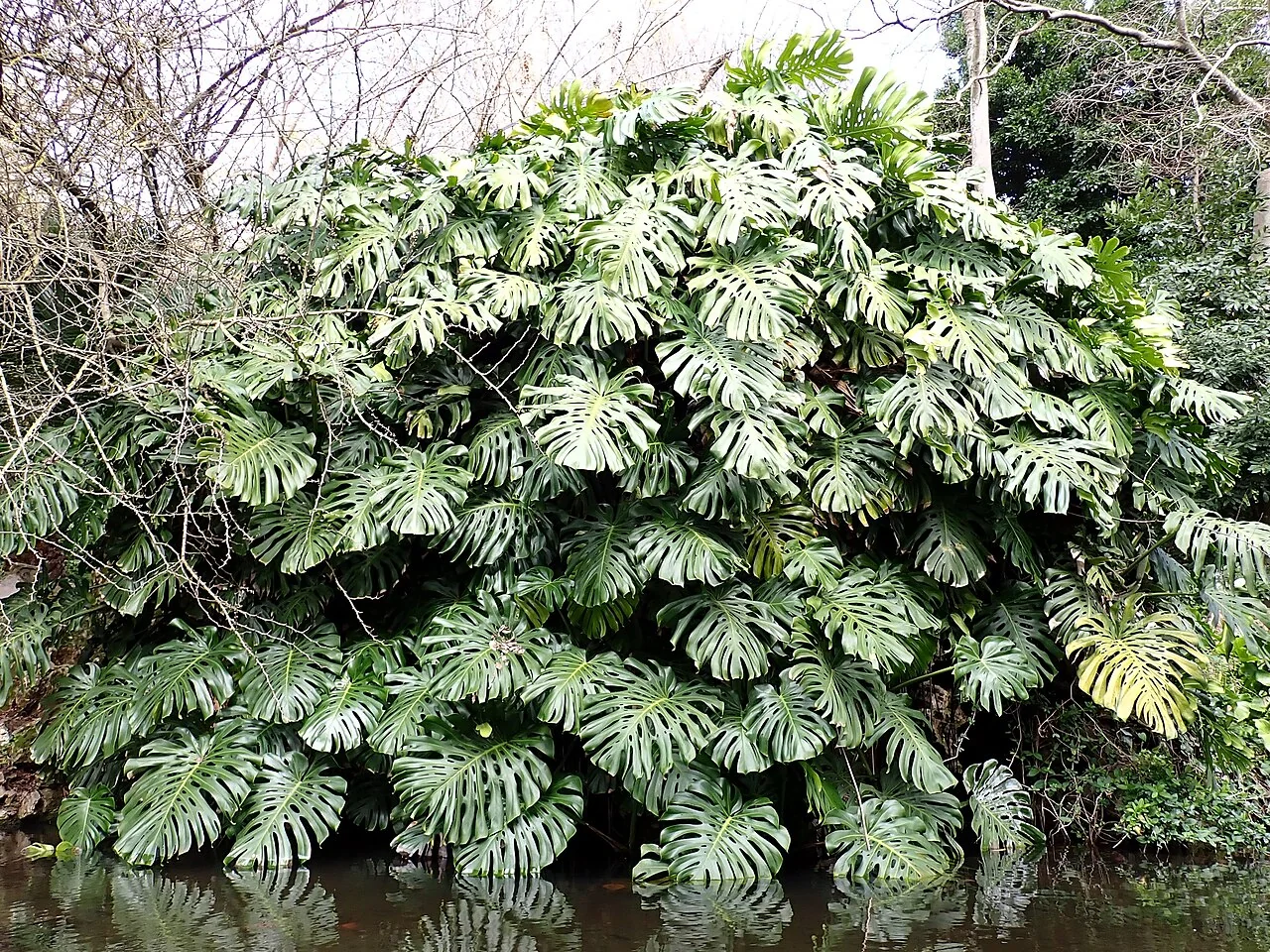
Monstera deliciosa is a climbing member of Araceae, not a Philodendron despite the common name split-leaf philodendron. NC State describes its broad, glossy adult leaves with both internal holes and deep marginal divisions. Juvenile foliage can be much simpler. NC State Extension: Monstera deliciosa
When shopping, ask for the botanical name and photograph the whole plant. The word monstera may refer to a different species, and a close crop of one perforated leaf can make the distinctions hard to assess. Record whether the sale pot contains one stem or several separate plants. A multi-stem pot gives immediate fullness but changes how many growing tips and support routes you will need to manage.
Do not use the number of splits in a nursery photograph as a guaranteed specification. It describes a leaf that already developed under particular conditions. Your useful buying information includes current stem structure, plant size, root condition, and the space needed to keep future growth accessible. The photo should help confirm identity and starting form rather than promise an exact next leaf.
Reserve a volume of room, not a circle on the floor
The Royal Horticultural Society notes that Swiss cheese plants can reach several metres indoors and become top-heavy, making container stability and eventual size real planning considerations. Royal Horticultural Society: Growing Swiss cheese plants
Mark where the pot will sit, then look outward along the leaf stalks. The usable space includes the sweep of leaves, the support behind the stem, and your own approach for inspection. A plant tucked tightly between furniture can fit its footprint while leaving nowhere for a new leaf to open. Open doors, curtains, and nearby drawers before deciding that the corner is suitable.
Choose an endpoint you can maintain. Perhaps you can accommodate a supported specimen near one window but cannot move a larger container through the doorway. Perhaps the available daylight falls on a tabletop rather than the floor. These are useful constraints to resolve before buying. They can lead to choosing a smaller specimen, a different location, or another plant rather than repeatedly trying to force the room around a growing vine.
Separate leaf maturity from a care diagnosis
University of Minnesota Extension distinguishes young unperforated leaves from the deeply lobed and perforated foliage of mature plants. The presence of an entire leaf is therefore not, by itself, evidence of a problem. University of Minnesota Extension: Monstera deliciosa
Follow a sequence of newly produced leaves on the same stem. Photograph the leaf, the section of stem beneath it, and the support arrangement. In a pot containing several plants, a small leaf may come from a younger stem while a large leaf belongs to an older one. Comparing them as though they were successive leaves can create a false impression that the entire plant is declining.
Ask first whether the new growth is sound and whether the plant remains manageable. If you want increasingly large foliage, allow enough space for that result and review the actual daylight available. Do not purchase a fertilizer or a pole solely because an advertisement implies it will deliver a particular number of holes. Development depends on a living plant in a changing environment, and a useful care plan acknowledges that uncertainty.
Support the stem and preserve access
Trace the main stem from the pot to its growing tip before installing anything. The petioles carry leaves away from that stem; tying a group of them together may make the silhouette temporarily narrower while interfering with inspection. Choose contact points you can see and revisit. Plan where the next section of stem will go, not only how to prop up the oldest leaning part.
Make the support and pot work as a single assembly. Check whether the anchor can resist the plant's weight without requiring a much larger volume of potting mix. Check whether the whole thing can be moved to its watering place. A tall pole that fits under the ceiling can still obstruct a doorway or stop the pot from sitting in a sink. A practical installation makes these movements possible before the vine attaches more firmly.
The leaf-splits, support, and space guide helps decide what growth you actually want. For comparing pole, trellis, and stake formats, use the separate indoor support guide. Your choice should follow the stem's route and the room's limitations.
Make the root zone visible in a large display
Large leaves can hide the soil surface, and an impressive outer pot can conceal standing water. Establish a way to inspect both before the plant becomes difficult to handle. Keep an accessible edge of growing medium and enough room to remove or empty the collecting tray. If you cannot reach the pot comfortably, moving the display is usually a better first step than automating an unknown watering requirement.
NC State advises thorough watering followed by drying of the upper part of the root zone. Its indoor size estimate of roughly six to eight feet is a reminder that an ordinary houseplant can still become a substantial object to maintain. NC State Extension: Monstera deliciosa
Treat a recent repot or move as the beginning of a fresh observation period. The previous interval between waterings may no longer describe the new arrangement. Note how the mix feels before watering and how much runoff remains afterward. When a plant is too heavy to lift, keep the observation method consistent and use several accessible clues rather than interpreting one leaf position as a moisture reading.
Plan any size reduction around living nodes
A Monstera cutting requires a stem node and axillary bud to produce new shoot growth. Minnesota Extension explains that a detached leaf and petiole without this structure cannot become a complete new plant. University of Minnesota Extension: Monstera deliciosa
Before shortening a vine, identify the portion that will remain in the pot and the portion you intend to root. Make sure both decisions fit the available space. Saving a large top cutting can leave you caring for two bulky plants instead of one. If the original issue was lack of room, propagation only solves it when you have a destination for the extra specimen.
Prepare a clean work surface, a receiving container, and a way to support the cutting before making the cut. Photograph the node and the chosen cut location so you can recheck your reasoning while the plant is intact. Do not cut a leaf merely because it is large if the real issue is a stem extending beyond the support. Pruning should address the structure that is causing the space conflict.
Choose a manageable long-term arrangement
UF/IFAS Extension highlights invasive risk for Monstera in warm Florida conditions and advises keeping it indoors in that context. A tropical plant's ability to grow outdoors is not enough to establish that it belongs in a particular landscape. UF/IFAS Extension: Monstera and outdoor suitability
For indoor equipment, a Mossify pole and adjustable VELCRO garden ties are relevant catalog items when they match the support route you have measured. Check usable height and fastening positions before ordering; their presence does not remove the need for a stable container. Keep leaf cleaning, support inspection, drainage, and eventual movement in the same maintenance plan.
At the end of an active growth period, review the available clearance around the newest leaves. Decide whether to maintain the present size, allow more growth, or prepare a planned reduction. A plant that remains reachable and structurally sound is a better long-term display than one whose impressive leaves prevent you from seeing its base. Make the next purchase only after that review identifies a task your existing setup cannot perform.
Sources and scope
Research-based guidance informed by institutional references. Cultivar, region and growing conditions can change the advice. Product inclusion does not imply hands-on testing of every model.